EmiState-HDR

A Synthetic Indoor HDR Multi-State Dataset and Learned Selection for Storing Observed Emissive States

Hogeon Lee1,2  ·  Jaerin Ko3  ·  Jangwon Lee1

1Sungkyunkwan University   2SFACSPACE   3Hongik University

Dataset Paper coming soon Code coming soon

Dataset DOI: 10.57967/hf/10897 · CC BY-NC 4.0

α = 0.0

Every frame is a separately rendered ground-truth state; no frames are interpolated.

4indoor scenes
13configurations
26state transitions
33,000rendered HDR EXRs
80 / 80 / 40base · target · evaluation views

Abstract

When a display or light in a room changes state, the walls and floor that receive its light change too. Revisiting observed emissive states from novel views requires one stored representation per state, yet no public indoor dataset with state-specific training views supports measuring how compactly an additional state can be stored.

We present EmiState-HDR, a synthetic high-dynamic-range dataset of four indoor scenes, 13 configurations and 26 state transitions, with disjoint training views per state, evaluation views shared by all states, intermediate-state ground truth with known state values, emissive-material masks, and a per-view linearity audit of the ground truth. With 3D Gaussian Splatting, keeping the same number of Gaussians from the same full target model under the same refinement, existing selection criteria span 5.06 dB in target-state PSNR. As a baseline for this protocol, EmiState-GS learns a per-Gaussian gate from the target observations and keeps exactly the specified number of Gaussians.
What the dataset provides

State-specific training views

Each transition has 80 base-state and 80 target-state training cameras that never overlap, as in real captures where each state is recorded separately.

Intermediate-state ground truth

States at α = 0.2, 0.5, 0.8 (TV: every 0.1) are rendered separately with known intensities, so the target and intermediate states can be scored at 40 shared evaluation views.

Unclipped HDR, audited

Renderer EXRs are released as saved. Every intermediate view is checked against the linear relation between the endpoints, and all flagged views are listed.

Emissive-material masks

Per-view masks of local emitters and light fixtures measure how much of a state change lies outside the emitter.

13 configurations

Target state of every configuration at one camera. Configurations of a scene change the content on the local emitter: a menu board, a picture frame, a sign or a TV screen.

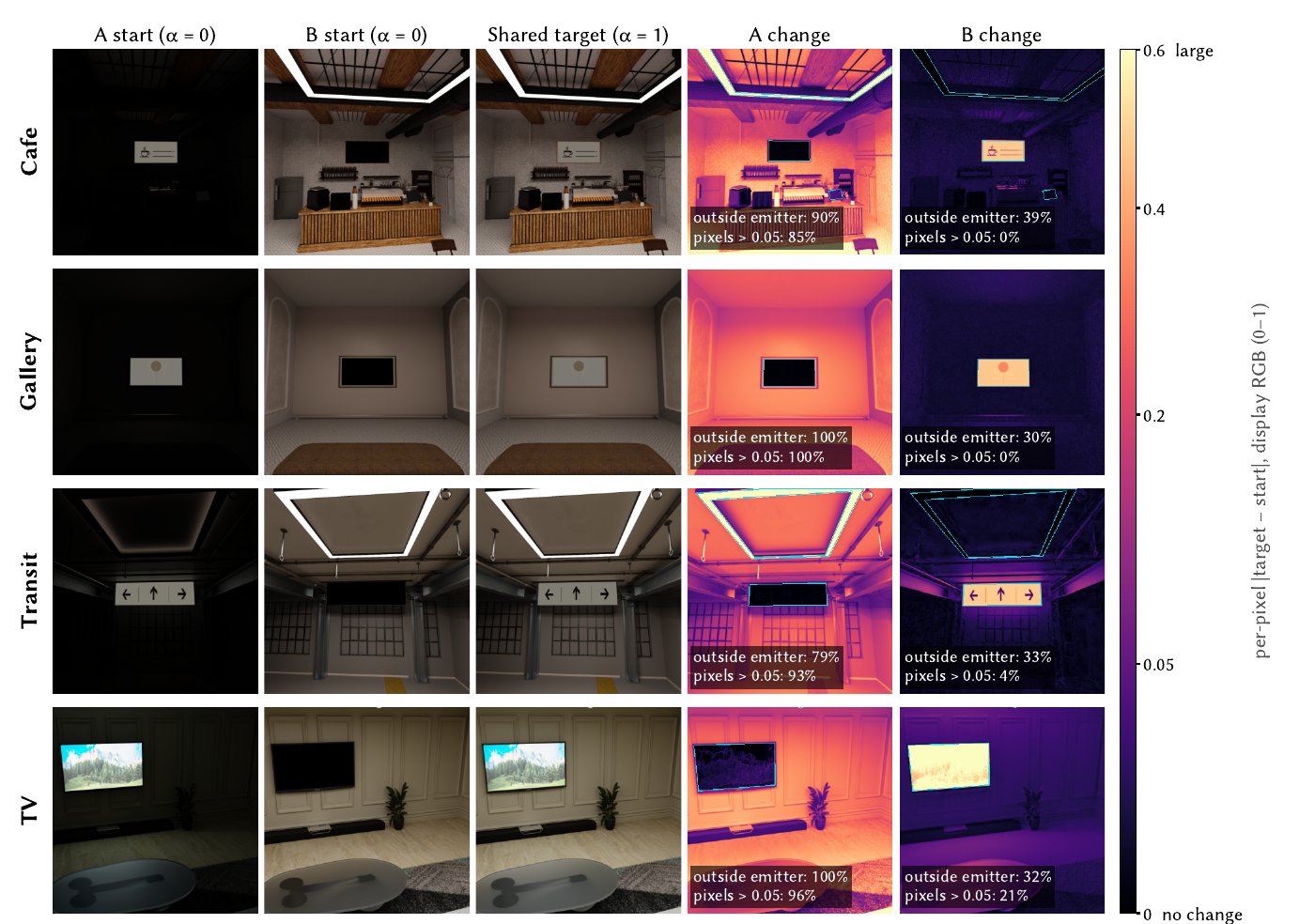
The change spreads beyond the emitter

Even when only a TV screen turns on, 53.1% of the display-space image change lies outside the screen, so a target state cannot be reproduced by updating the emissive region alone.

Base states, shared target state and change maps of the A and B transitions in the four scenes
A transitions raise the room lighting; B transitions raise the local emitter. Cyan outlines mark the emissive-material mask.

Comparison with existing resources

ResourceTypeScenesImagesHDREmissive maskState-specific viewsIntermediate-state GT
HDR-NeRFReal/synth., fwd.122,100partial✕–✕
Multi-IlluminationReal, indoor1,01625,400✓✕–✕
NeRF-OSRReal, outdoor83,240partial✕partial✕
OpenIlluminationReal, object64108k+✕✕✕✕
Eyeful TowerReal, indoor1128,680✓✕–✕
ESR-NeRFSynth., object123,000partial✓✓✓ (0.5×)
EmiState-HDRSynth., indoor433,000✓✓✓✓ (3; TV 9)

Selected rows of Table 1 in the paper; entries follow each resource's original paper or official release.

Benchmark: storing an additional state

All methods keep the same 20% of the Gaussians of the same full target model and use the same refinement; the shared base-state model is stored once. Mean over the 26 transitions.

MethodTarget PSNR ↑ALL4 PSNR ↑SSIM ↑LPIPS ↓Storage (MiB) ↓
Full (unselected reference)29.5128.420.90820.1687507.35
Random selection23.5925.040.83380.2940253.83
LightGaussian28.2727.770.90150.1816253.83
Compact3DGS mask29.3928.510.90380.1861253.83
PUP 3D-GS24.3325.240.84270.2620253.83
EmiState-GS (baseline)30.1328.960.90890.1754253.83

Storage is the FP32 cost including the shared base model. ALL4 averages the target and three intermediate states.

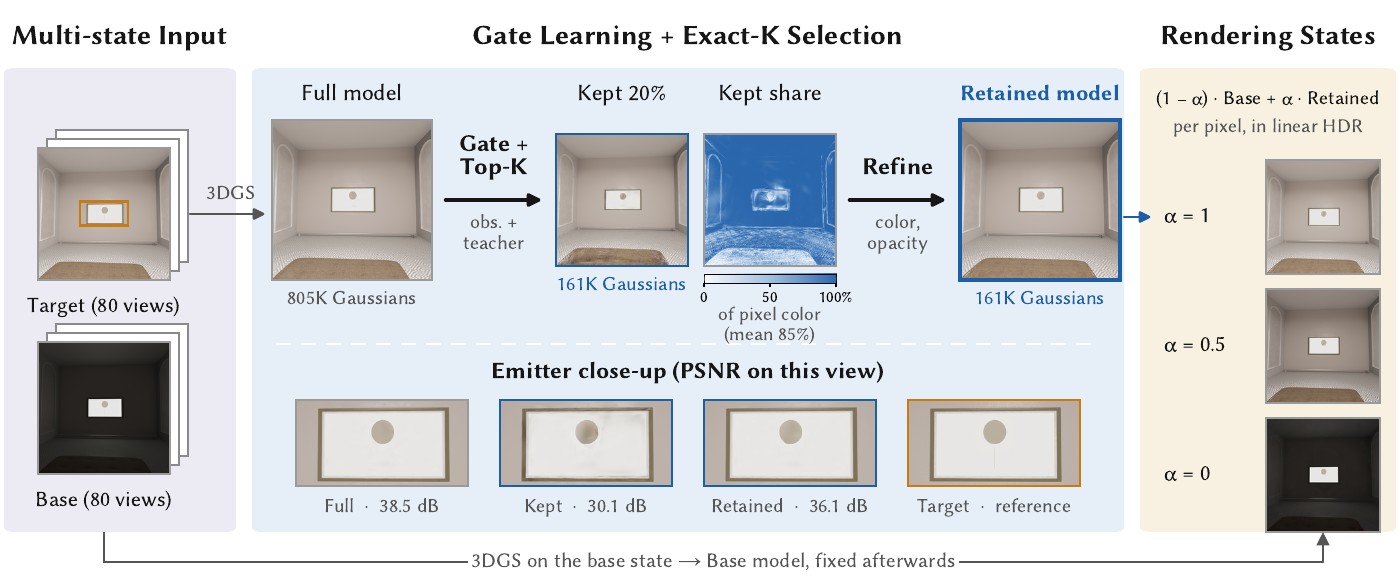
Overview of EmiState-GS
EmiState-GS learns a per-Gaussian gate from the target observations and keeps exactly K Gaussians before a short refinement.

Download and format

pip install -U huggingface_hub
hf download logun99/EmiState-HDR \
  --repo-type dataset --local-dir EmiState-HDR

About 254 GB. Single scenes can be fetched with --include "scenes/tv/*". A real two-state Office capture with its COLMAP registration is included.

scenes/
HDR EXRs per scene, configuration and state (200 cameras each), with cameras.json
transitions/
One file per transition: states and the 80 / 80 / 40 view split
masks/
Emissive-material masks at the evaluation views
audit/
Per-view ground-truth audit results
office/
Real two-state capture with COLMAP registration
tools/
Reader, display transform, PSNR and compositor inversion

Released under CC BY-NC 4.0. Scene assets come from BlenderKit and are not redistributed; only rendered results are released.

Citation

@misc{lee2026emistatehdr,
  title  = {EmiState-HDR: A Synthetic Indoor HDR Multi-State Dataset and
            Learned Selection for Storing Observed Emissive States},
  author = {Lee, Hogeon and Ko, Jaerin and Lee, Jangwon},
  year   = {2026},
  doi    = {10.57967/hf/10897},
  url    = {https://huggingface.co/datasets/logun99/EmiState-HDR}
}